
Feathers
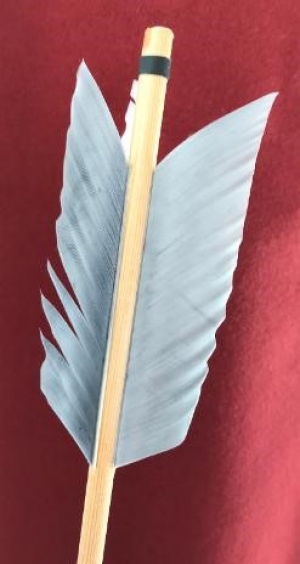
Until modern times, arrows were fletched with feathers. Due to preparations for the ongoing conflict with France, feather-collecting orders were made twice in the 1400s, in early 1417 and July 1426, along with the need to obtain wax, silk and timber for arrow production.
Roger Ascham had a great deal to say about feathers in his book Toxophilus, published in 1544. Feathers were the only suitable material for fletching, and as far as he was concerned, only goose feathers were remotely suited to the task, because: ‘The goose is man’s comfort in war and in peace….’.

Coat of Arms
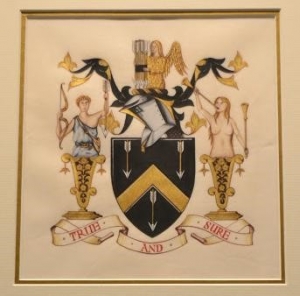
The Worshipful Company of Fletchers’ coat of arms is ‘sable, a chevron gold, thee broad arrows of the same, garnished silver’. The crest shows an ‘angel proper’ on a wreath of gold and sable. She holds in both hands a bundle of arrows.
The Fletchers’ motto – adopted on 25 November 1872 – is ‘True and Sure’ which refers to the requirement of an arrow to bend round the bow when loosed and fly straight almost immediately so that the arrow hits its target.
The Worshipful Company of Fletchers received its Grant of Arms on 12 October 1467 – see 49 for further information. The crest was granted in 1486.
In the process of petitioning for a Royal Charter in 2020 it was discovered that the Supporters that appeared on the Arms that were in current use had never been approved by the College of Arms. If the Arms including the Supporters were to feature on the Royal Charter, assuming it be granted, it would be necessary that the Arms including the Supporters be approved by the College of Arms. An application to the College was duly made, and on the 10th June 2020 the use of the Supporters approved. The College suggested that wording to the following effect should appear on the Royal Charter:
“That by Letters Patent under the hand and Seal of Clarenceux King of Arms bearing date the Twelfth day of October 1467 certain Arms were appointed given and granted to The Master and Wardens of the Mystery and Craft of Fletchers of the City of London That a Crest was granted to the said Company by Clarenceux King of Arms in the second year of the reign of King Henry VII That the said Arms and Crest were viewed ratified and approved by Sir Henry St George Richmond Herald in 1634 That the said Company is now known as The Worshipful Company of Fletchers That certain Supporters were granted unto the said Company under the hand and Seal of Garter King of Arms bearing date the Tenth day of June 2020”. The new, approved Supporters and Coat of Arms are shown below.

The “new” Supporters are described by the College as below:
Supporting with their elbows proper issuant from a Campana Urn Sable garnished and charged with four Roses three in chief one and two and one in the nombril point all with slips conjoined and leaved Or on the dexter a young Man proper crined Or vested with a Cotton Toga proper belted a Bag over the sinister hip pendent from the dexter shoulder holding in the dexter hand a Bow string outwards and in the sinister hand an Arrow point downwards all Or barbed and flighted Argent and on the sinister a naked Maiden proper crined and winding a Trumpet bendwise held in the dexter hand and holding in the sinister hand a like Trumpet palewise bell upwards all Or.
Fletchers’ Prize Arrows
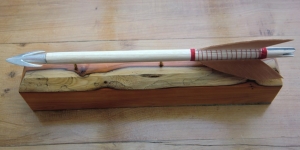
Prize arrows made by Honorary Liveryman, Lindsay Head and her husband and Liverymen of the Bowyers’ Company, Richard, are put on display at Fletchers’ dinners, and are also given to various worthy recipients.
The arrow in the picture – which measures nine inches overall – is made from poplar, a wood commonly used for arrows in the Medieval period. The shaft ‘bobtails’ i.e.: it tapers from the head to the nock end, a profile common in war arrows.
A slot is cut in the nock end and the makers glue in a horn insert to strengthen it, a method used on the arrows recovered from the Mary Rose.
The arrow is fletched with the brown wing feathers from a peacock as these are very strong. After gluing them to the shaft they are bound on with red silk – this was intended to stop the feathers coming off in wet weather as the glues in the Medieval period were not waterproof.
The arrowhead is made to a Medieval pattern in solid silver. The whole arrow is then supported off the yew base by two brass rods to give the impression that the arrow is flying through the air.
(excerpts from an article by Lindsay Head, La Fleche issue 47b January 2017)
Shrieval Badge and Armorial Bearings – Bernard Joseph Brown (1916 – 2012)
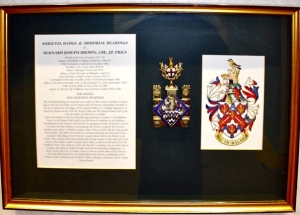
Bernard Joseph “Joe” Brown CBE, JP, FRICS had a long and distinguished career of public service, including his role as High Sheriff of the City of London 1977-78. He was Master of the Worshipful Company of Fletchers in 1986-87. He was awarded the CBE in the 1982 New Years’ Honours. Mr Brown’s shrieval badge and armorial bearings are displayed at Farmers’ and Fletchers’ Hall as shown above.
The armorial bearings are mounted on a model of Alders Gate, a northern entrance gate to the City of London in the Ward which Mr Brown represented. Inscribed on the two columns are the badges of the Royal Artillery & Combined Operations in which Mr Brown served 1939 – 46, the Round Table and the United Wards Club of the City of London of which he was a member.
The helmet on the armorial bearings denotes an Esquire. Above this is the Barbican Tower on the Roman wall which was visible from Mr Brown’s residence in the Barbican. Coming out of the Tower on the left-hand side is the Shrieval Fist grasping a bundle of Fletchers’ arrows (five arrows for five children). Surmounting the Tower is a jay for Mr Brown’s familiar name of Joe. Also above the helmet is a wreath indicating the National Colours, and above that foliage for Mr Brown’s country home.
Below the helmet is the shield. This contains three lesser shields each having a Saxon cross taken from the arms of the Greater London Council, and a seaxe, a Saxon sword taken from the Middlesex arms. The chevron is from the Fletchers’ Company coat of arms with at the apex the fasces (a bound bundle of sticks with hatchet denoting a Magistrate). St Paul’s sword (the City of London arms) is shown on both sides of the chevron. The wavy blue lines across the shield indicate Mr Brown’s membership of the Thames Water Authority and the River Thames Advisory Committee of the London Tourist Board.
Arrowhead
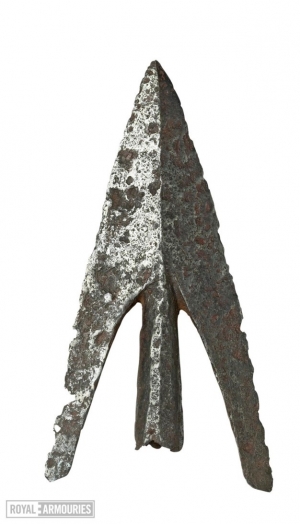
Roger Ascham, 1500s archery expert and author of ‘Toxophilus: The Schole or Partitions of Shootinge’, had the following opinion on arrowheads: ‘Our English heads be better in war than either forked heads or broad arrowheads. For first, the end being lighter, they fly a great deal the faster, and, by the same reason, giveth a far sorer stripe [hit or wound].’ By the time that Toxophilus was published, recreational archery was becoming far more popular, so Ascham went on to describe the different types of arrowhead available for that purpose: sharp or blunt-pointed and sometimes with a ridge so that the archer could tell that the arrow had been drawn fully.
The arrowhead in the picture is European and dates to 1400-1499.
Image reproduced by kind permission of the Royal Armouries.
Master’s Declarations
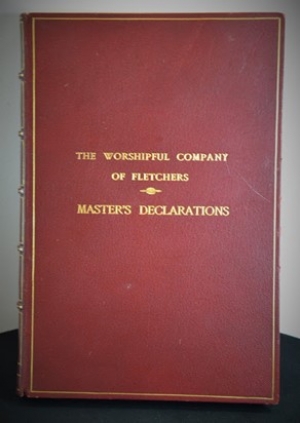
The proposal that incoming Masters of the Worshipful Company of Fletchers should sign a declaration was made in 1938. Masters only began doing this from 1945, after a book was presented by Mr Vining on 11 May 1943. The declaration states that the Master will execute the office justly, faithfully, and diligently. The first such declaration was signed by Frederick John Monkhouse Esquire on 18th July 1945.
Fletchers’ Lapel Pin
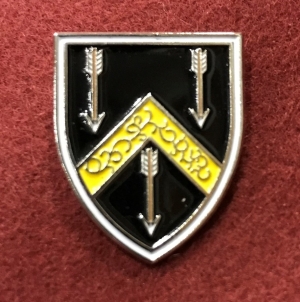
Fletchers often wear a lapel pin in the shape of the Fletchers’ shield to show that they are members of the livery, or they give them to their partners as a gift. Some of the Fletchers have even made them into cuff links to wear at events, as well.
Field Marshal Montgomery
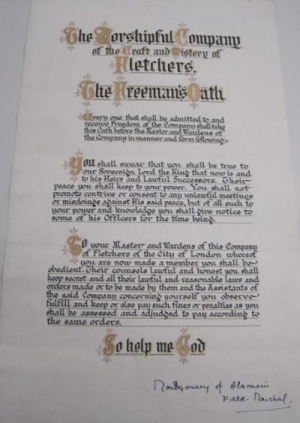
At a meeting on 29 November 1945, the Court discussed the question of admitting distinguished persons to the Freedom and Livery of the Company by Gift. The Court unanimously decided to offer Field Marshal Bernard Law Montgomery (1st Viscount Montgomery of Alamein, KG, GCB, DSO, PC, DL) the Freedom and Livery of the Worshipful Company of Fletchers ‘as a token of this Company’s appreciation of the magnificent services to this Country rendered by all Members of His Majesty’s Army’. He received the Honorary Freedom of the Company on 12 July 1946. At the lunch after the ceremony, he very kindly donated the first £100 to help youth charities, particularly smaller ones, which depended on voluntary help. On 30 October 1946, an evening with music for members and their ladies was held to give them the opportunity to meet the Field Marshal. The photo is of Field Marshal Montgomery’s Freeman’s Oath; all Fletchers have to swear this oath on joining the Livery.
Reproduced by kind permission of the London Metropolitan Archives
Lewisham Air Cadets Illuminated Manuscript
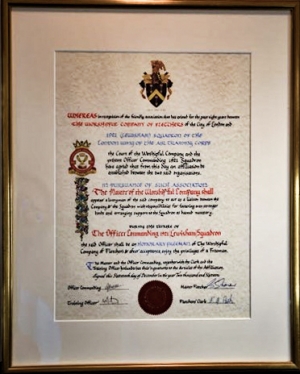
The Fletchers have been closely associated with 1921 (Lewisham) Squadron of the Air Training Corps since early 2008. Liverymen regularly attend many of the squadron’s events and, since 2014, the Master Fletcher has made an award of a silver prize arrow to the cadet who has best displayed the virtues of the Fletchers’ motto “True and Sure” throughout the year. The cadets regularly support Fletchers’ events by providing formal carpet guards for livery dinners. In 2012 they marched with the Company in The Lord Mayor’s parade when Past Master Fletcher Sir David Wotton was elected Lord Mayor.
1921 (Lewisham) Squadron is very active and regularly excels in London ATC Wing competitions. They have an excellent record for bringing on their youngsters and achieving promotions to the highest cadet ranks by the age of 18. Lewisham is the only squadron in the country in the past 10 years to have had three cadets awarded flying scholarships in a single year.
In recognition of this longstanding friendship and cooperation, in December 2016 the Fletchers and 1921 Squadron became formally affiliated, marked by an exchange of illuminated manuscripts, as shown in the photo above.
Arrows from the wreck of the Mary Rose
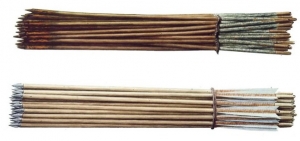
Archers continued to be a vital part of the army in the 16th Century. Over 3,500 arrows were recovered from the wreck of the Mary Rose, Henry VIII’s flagship which sunk in the Solent on 19 July 1545. The top image shows the arrows recovered from the wreck – although both the arrow heads and the feathers have deteriorated away, the marks from the binding of the feathers to the shafts are still visible. The bottom image shows how the arrows would have originally looked, with goose- or swan-feather flights. The majority of the arrows from the Mary Rose were of poplar.
Image reproduced with the kind permission of the Mary Rose Trust.