
Royal Charter 2021
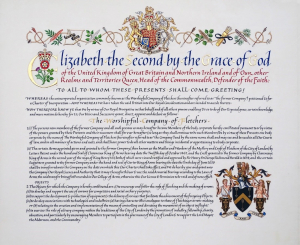
After 650 years of not being a Chartered Company, the Worshipful Company of Fletchers petitioned for the grant of a Royal Charter in 2020. The Royal Charter is granted by the Her Majesty the Queen and is an instrument of incorporation which confers independent legal personality on the Fletchers and defines its objectives, constitution and powers to govern its own affairs.
The documents were approved by the City Corporation and then submitted to the Privy Council, who granted final approval to affix the Great Seal on 26 May 2021. The Charter was presented by the Princess Royal at the Fletchers’650th anniversary banquet at Mansion House on 7 March 2022, the largest ever gathering of Fletchers and their guests.
Women’s Quarterage Payments
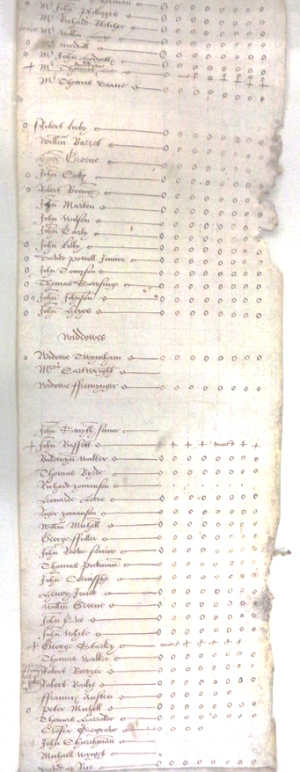
It was not uncommon in medieval London for women to play an active part in their husbands’ businesses during the former’s lives, and also to continue these enterprises after their deaths, but the practice seems to have been particularly common among the Fletchers. The Worshipful Company of Fletchers’ early quarterage registers regularly show widows assuming their husbands’ places on the latter’s deaths. By the 1560s, when these lists began to separate out the leading Fletchers as ‘masters’, separate sections for the widows were also introduced. In some instances, these fletcher widows make only a brief appearance, perhaps continuing payments to the Company only while winding up their husbands’ affairs, but in other cases it seems clear that they continued to run fletching businesses in their own right, and sometimes for prolonged periods.
From The Worshipful Company of Fletchers of London: The Early Centuries c. 1371 – c. 1571 by Dr Hannes Kleineke, 2021
Guildhall Library, London, MS 5977
Master's Badge
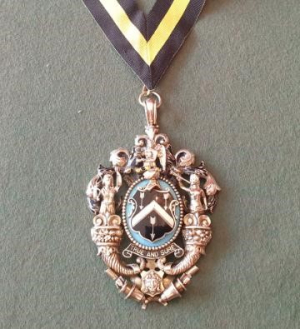
The Worshipful Company of Fletchers is led by the Master aided by a Court of Assistants and the Clerk. The Master is elected for a year and presides at all Fletchers’ functions. Before the Master’s time in office, he/she plans several additional activities and trips for the year in addition to the usual calendar of events, and organises the famous Fletchers’ autumn holiday.
Their silver guilt Badge is formed as two cornucopiae with supporters above, one of a female figure holding a bow and arrow, the other a male figure blowing a horn, the top angel holds a bundle of arrows. The centre shows the Company shield, in silver and black upon a pale blue enamel background. The badge was made circa 1900 by C. Krall.
Dinnercard - 600th Anniversary Dinner
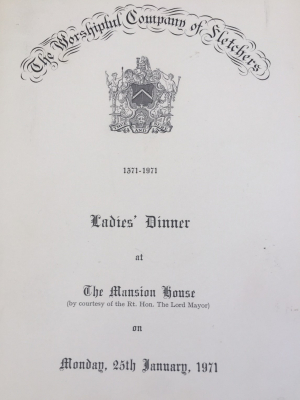
To celebrate their 600th Anniversary, the Fletchers held a dinner at the Mansion House on 25th January 1971 – the dinnercard is shown above. The event was hosted by the Master C J Maples. A five-course dinner was served along with Moselle, Bordeaux, port and brandy.
Finsbury Fields
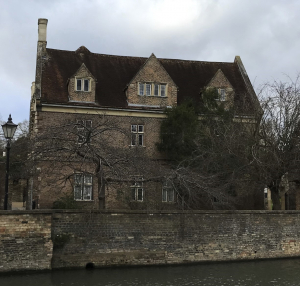
Archery began at Finsbury Fields in North London in around 1498 and was later strongly encouraged by Henry VIII. Ayme for Finsbury Archers was first published in 1590 and describes the marks and longbow targets at Finsbury Fields, set up for longbow shooting at distances of at least 180 yards. It was reprinted in 1594 and 1601 – a 1601 edition is kept at the Pepys Library, Magdalene College (pictured) and the book itself may be viewed at: https://magdlibs.com/2015/03/20/pepys-and-archery/#:~:text=Ayme%20for%20Finsburie%20archers%20is,to%20Islington%2C%20Hoxton%20and%20Shoreditch.
It is possible that archery continued in Finsbury Fields until the late 18th Century. The Finsbury Archers ceased in 1770 but their remaining members formed the Royal Toxophilite Society in 1780.
1371 Petition
The earliest livery companies were formed in the early Middle Ages as trade guilds. They were both employers' federations and trades unions, and their functions included ensuring high standards of business conduct and product quality from all their members, helping in the education of future generations in the particular ways of the trade or craft, and supporting those members of the company or their families who had fallen on hard times or were suffering from poor health.
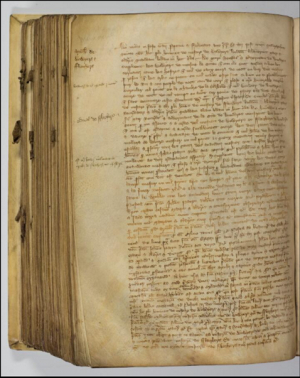
On 7th March 1371, the Fletchers presented a petition (pictured) stating that they had agreed ‘for the profit and advantage of all the Commonality’ that the two trades of Bowyer and Fletcher should be kept entirely separate, and no man engaged in one trade was to meddle with the other in any way; anybody so doing was to pay to the City Chamber 40 shillings for the first offence, £4 for the second, and so on, the fine being doubled for each successive offence. This petition was granted, and thus the Worshipful Company of Fletchers came into existence.
Second paragraph from The Fletchers and Longbowstringmakers of London by James E Oxley, 1968
Image reproduced by kind permission of the London Metropolitan Archives
Farmers’ and Fletchers’ Hall
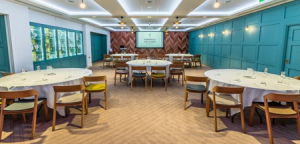
It is a proud boast of the Fletchers’ and Farmers’ Companies that their new Hall was the first Livery Hall not actually constructed on the site of a previous Hall to be built in the City of London for 250 years.
The Hall’s foundation stone was laid by the then Lord Mayor Sir Alan Davies on 4 April 1986 and building work went forward throughout that year. The Livery Hall for the Farmers and Fletchers was completed in early May 1987 and the official opening by Her Royal Highness Princess Anne, the Princess Royal, took place at a lunch at the new Hall on 9 June 1987. This was the first time that there had been a royal presence at a Fletchers’ Company function.
The Hall was subsequently refurbished in 2014-16.
First two paragraphs from The Fletchers’ Company of London 1969 to 2010 by Michael Roberts MA MCLIP, Honorary Archivist to the Company
Placemat
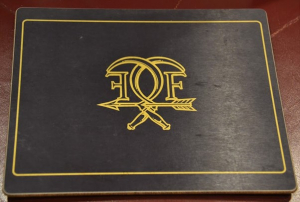
These placemats were in use at Farmers’ and Fletchers’ Hall prior to the Hall’s refurbishment from 2013-15. Fletchers remember them in use 15 years ago and more. They looked good on the oak tables that were in service at one stage but were used little after those tables were replaced as part of the refurbishment.
RAF Northolt Affiliation
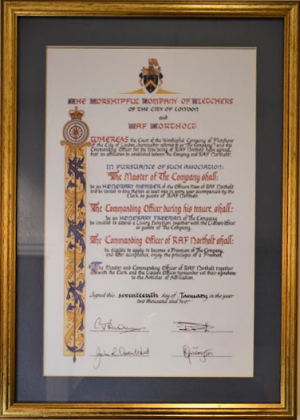
As well as affiliations with the British Army and the Navy, the Worshipful Company of Fletchers is delighted to be affiliated with the Royal Air Force. Rather than a single squadron, the Fletchers are affiliated with an RAF Station, Northolt. An operational aerodrome since March 1915, it has been a base for military operations for over 95 years.
The picture above shows the formal affiliation document with RAF Northolt, signed on 17 January 2002. During his or her time in office, the Master is an honorary member of the Officers’ Mess, and the Commanding Officer of the regiment is an Honorary Freeman of the Company and is eligible to become a Freeman of the Company.
The Commanding Officer and other representatives from Northolt are invited to the Fletchers’ Affiliates lunch, to both update members on the base’s activities and for the Master to award someone from the base with a Fletchers Prize Arrow. In October 2019 the Fletchers enjoyed a visit to the Air Historical Branch at RAF Northolt.
Clerk's Gown
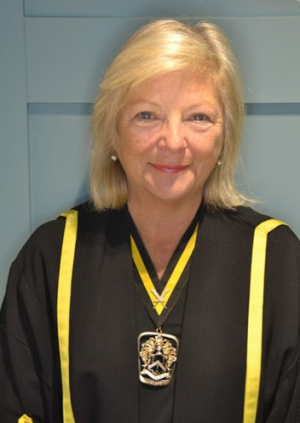
The Clerk ensures the smooth running of the Worshipful Company of Fletchers, including looking after the membership, attending and taking minutes at meetings and Court, looking after the finances, organising events and a hundred and one other useful tasks. The Clerk’s role may be considered to be similar to that of a Company Secretary in a limited company.
The Clerk, Master, Upper Warden, Renter Warden and Beadle wear gowns for ceremonial occasions such as dinners and church services and also at Court.
The first known Clerk of the Company was Abraham Hemingway, who drew up the early eighteenth century list of Liverymen. The first Clerk recorded in the Minutes is James Roberts, who resigned on 22 October 1782, and was probably Clerk when the minute book began in 1767. The current Clerk is Kate Pink, pictured wearing the gown and badge of office.